
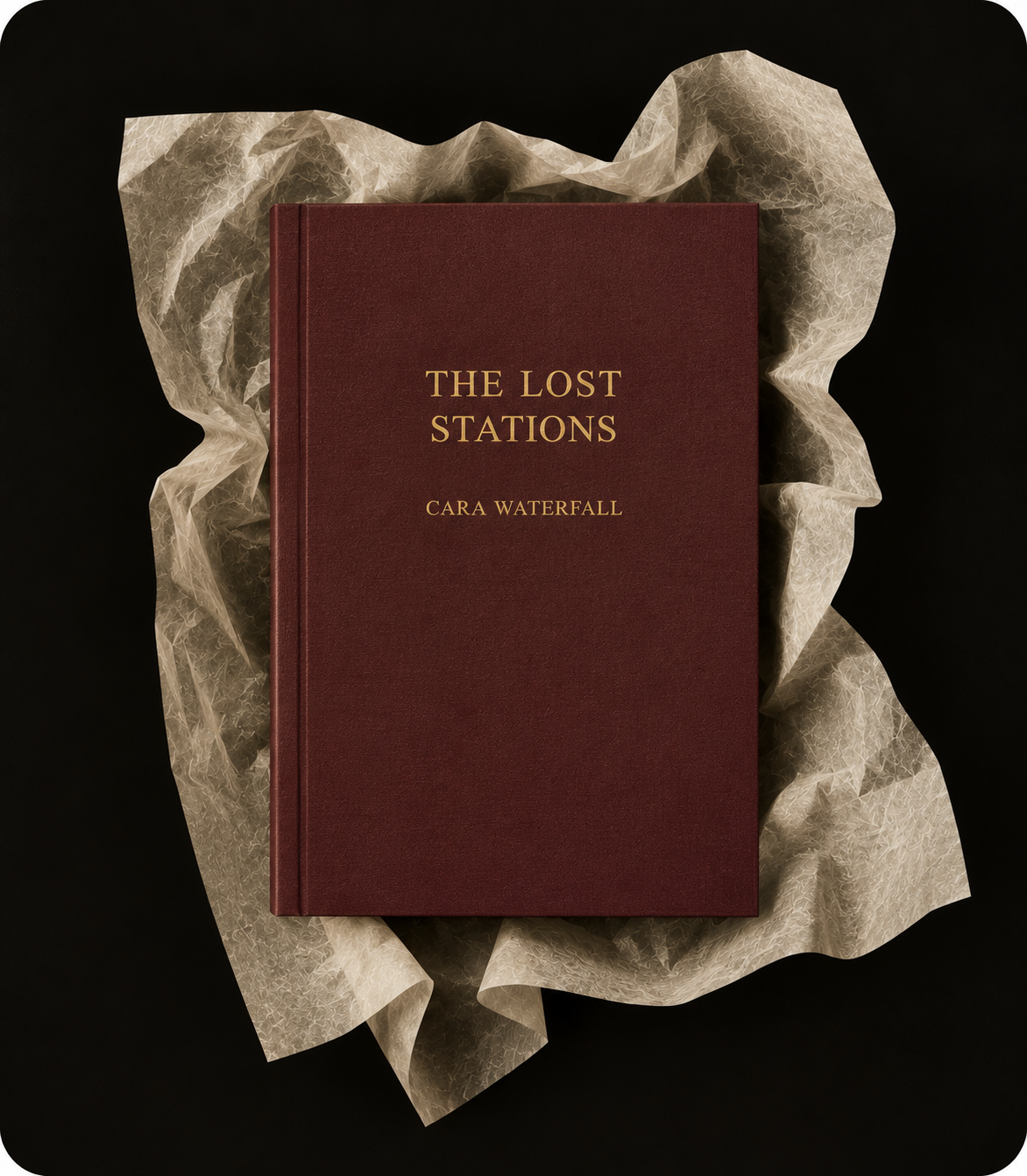
The Lost Stations
Cara Waterfall's debut with Ink & Ribbon Press moves through grief, ecology, and the fragile infrastructures that carry life forward — a collection that listens for what remains after rupture.
The Lost Stations takes its title from the decommissioned rail stops along Toronto's Beltline Trail — places where the speaker once walked with her father, now overgrown or nearly erased. These abandoned sites become a governing metaphor for interrupted passage, inheritance, and all the ways landscapes hold on to memory.
Written across borders during a period of global crisis, the collection resists the pandemic as its sole frame. Private mourning opens outward into fossil records, migratory routes, damaged habitats, and domestic thresholds — the fragile infrastructures we rely on to carry life forward.
"The world of dew
is a world of dew —
and yet — and yet" Kobayashi Issa
Elegy as an act of attention.
The Lost Stations is structured in three movements — Traces, Vessel, and Tracks — each approaching loss at a different scale: ecological, domestic, and deeply personal.
Recurrent motifs — snow, transit corridors, hospitals, animals, weather — function as stations where meaning accumulates, erodes, and reforms. Drawing on lyric and hybrid forms including centos, contrapuntals, and duplexes, the collection approaches elegy not as resolution but as sustained attention.
The poems listen for what remains after rupture: traces, residues, and the quiet labor of endurance shared by human and more-than-human worlds alike.
- Title The Lost Stations
- Author Cara Waterfall
- Publisher Ink & Ribbon Press
- Publication November 2026
- Format Paperback
- Edition Limited Edition
- ISBN TBA
- Price $18.95
Loss as a systemic and ecological condition.
This is a collection that holds grief at multiple scales — personal, civic, environmental — without collapsing them into one another. Precisely the kind of ambitious, formally inventive poetry Ink & Ribbon exists to publish.
- Structured in three movements — Traces, Vessel, and Tracks — each approaching loss from a different vantage: the geological, the domestic, the familial.
- Draws on hybrid forms including centos, contrapuntals, duplexes, and zuihitsu, demonstrating formal range and technical command.
- Situates private mourning within ecological and historical scales — fossil records, migratory routes, damaged habitats — without losing intimacy.
- A winner and finalist across multiple major prizes; poems placed in Best Canadian Poetry, The Fiddlehead, Room, and elsewhere.
Open the poems as if opening the book.
Three poems from the manuscript, each a different window into the collection's sensibility — its grief, its formal invention, its attention to the world.
Snow in April I
The book's opening elegy — tender, crystalline, exact. A father hiking, a child learning windchill, snow falling into open palms: how we hold fugitive light.
Hummingbird Elegy
A tiny death witnessed with full presence — a prism thickening into gleam, a rapier beak, a last screech like a rosary. One of the collection's most arresting lyrics.
Griefbody: Winter
A formally daring palindrome poem — the same lines folded back on themselves, grief mirrored in structure. A standout example of the manuscript's range.
Poems from the manuscript have already found readers.
Individual poems from The Lost Stations have been recognized by major prizes and placed in leading literary journals.
1st Place, Room's 2020 Poetry Contest
1st Place, PULPLiterature's Magpie Award for Poetry 2022
Editors' Prize, PULPLiterature's Magpie Award for Poetry
Shortlisted, CBC Poetry Prize 2019
Finalist, Radar Poetry's The Coniston Prize
Finalist, Radar Poetry's The Coniston Prize
Cara Waterfall

Cara Waterfall is a bilingual poet, mentor, and storyteller whose work explores language, memory, and belonging through English, French, and Nouchi — the hybrid Ivoirian urban language that fuses French with local and borrowed vocabularies.
Born in Ottawa and currently based in Abidjan, Côte d'Ivoire, she has also lived in France, Ghana, Costa Rica, and England. Her debut collection, Radiant Wound (Unsolicited Press, 2025), explores post–civil war trauma in Côte d'Ivoire and how conflict reshapes language.
A CBC Poetry Prize shortlistee and three-time finalist for Radar Poetry's Coniston Prize, her work has appeared in Best Canadian Poetry, The Fiddlehead, Room, and The Night Heron Barks. Through Archipel, her digital publication and mentorship platform, she advances a gate-free literary ethos centered on sustained creative practice over status or access.
Publication details and pre-orders coming soon.
The Lost Stations will be published by Ink & Ribbon Press in a limited edition. Follow the press's Substack for updates on publication date, pre-order availability, and events with the author.